Daniel Tracey and family (Roscrea, Montreal and
Albany)
Alumni Duublinenses:
Trinity Dublin
Tracey, Daniel, Pen. (Mr Morris), Dec 5, 1814, aged 20; R.C., s. of Denis, Mercator; b. King’s Co. (Offaly)
Dennis Tracey & Anne Manford
Daniel Tracy b.c. 1794 Kings Co. d. 1832 Montreal QC
Ann Tracy (c1807-11th February 1879)
John Tracy (c1809-1875) Frankford
25
Jul 1800 Memorial No: 388002
Witness: Dennis Tracy/Tracey, merchant,
Frankford, King's Co [Offaly]
22
Mar 1806 Memorial No: 406069
Michael Horan, farmer?, of Ushkeane [Uskane],
Co Tipperary and James Horan, farmer, of Raheenmoyle [Raheenmeel Ballyboy],
Barony of Ballyboy, King's Co [Offaly] leased to Denis Tracy, Shopkeeper, of
Frankford, King's Co [Ballyboy Offaly], part of Raheenmeel, Barony of Ballyboy,
King's Co [Offaly].
20
Jul 1808 Memorial No: 410581
Witness Denis Tracy of Frankford, King's Co
[Offaly]
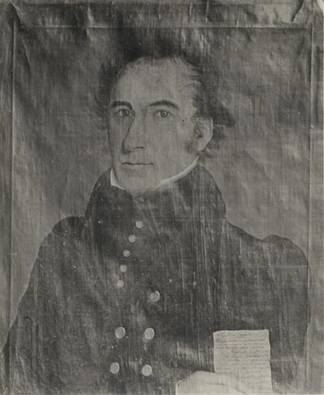
1. Daniel
Tracey (1794-1832),
physician, journalist and politician.
|
|
The
details of his life in Ireland are sketchy. While he was editor of the
Vindicator, he is listed as being from Kings Co (Offaly). An account of his
life was printed in The Vindicator in 1833 after his death (see below).
Surprisingly, the account was taken from another newspaper, the Irish
Republican Shield [New York?]. This
account states that he was born in Roscrea, Co. Tipperary, in May, 1795, the
son of Michael Tracey, a merchant and ??? Mainfold of Erescourt, Birr Co. Offaly. He was orphaned at a young age and
an uncle on his father’s side raised him and a brother and sister. At the age of ten he was removed from a seminary in his
native town to a school in Clonmel. He was educated at Trinity
College, Dublin, and after graduation studied medicine at the Royal College
of Surgeons, Dublin. He practised medicine in Dublin for several years; but
in 1825 he emigrated to Canada with his brother and sister. According to
Reynolds, Dr. Daniel Tracey
(who changed the spelling of the name) was of an Irish branch of the
well-known English family, and by much the eldest of four orphaned children,
a graduate of Trinity College and of its medical school, he was a practicing
physician residing in Offaly county, Ireland, when the accidental death by
drowning of a younger brother, to whom he was fondly attached, led him to
decide on a change of residence to Canada. After a shipwreck in the Gulf of
St. Lawrence, he arrived in Montreal in the year 1825, having with him his
brother, John, then a lad of fourteen years, and his sister, Ann, aged
fifteen. The Trinity College record is as follows: Daniel Tracey, Pen. (Mr Morris), Dec 5,
1814, aged 20; R.C., s. of Denis, Mercator; b. King’s Co. (Offaly). A French
reference, based on this, states that
his father was Denys (Denis) Tracey a merchant of Offaly and his mother Anne
Manford. His life in Canada
is well documented. He began the practise of his
profession in Montreal in 1825 and lived in either on St. James Street or in
the then St. Antoine Suburbs. In 1828 he established the Vindicator,
a Reform newspaper, and became its editor. When news of
O’Connell's electoral victory arrived in Lower Canada in September 1828
Tracey organized the province’s first Friends of Ireland Society. In May
1832, he was elected to represent the west ward of Montreal in the
Legislative Assembly of Lower Canada. He died of cholera in Montreal on July
18, 1832, after tending the
sick Irish immigrants who had fled the scourges of famine, disease, and
impoverishment in Ireland only to contract cholera on board ship. |
|
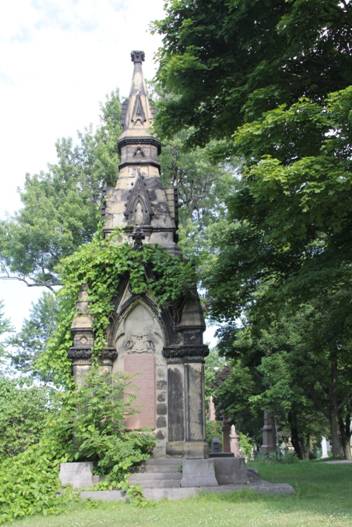
When the Côte des Neiges Cemetery was opened in 1855 his body was
reinterred there, and in 1866 his brother John Tracey, who had left Montreal
about the time of the outbreak of the rebellion of 1837 and settled in
Albany, New York, erected a large monument, at a reputed cost of 10,000
dollars (£2,000 sterling), over the grave which contains the following
inscription in English and French: "Here repose the remains of the late Daniel Tracey, M.D.,
who died of cholera, 19th July, 1832. He was a native of Roscrea County,
Tipperary, Ireland, and a graduate of Trinity College, Dublin. His career in
Canada was distinguished by devotion to the liberties of the country which he
ably and fearlessly advocated in The Vindicator newspaper, established by him
in 1828 and of which journal he continued editor to the time of his death. By
order of the Legislative Council he was imprisoned ten days in Quebec for
alleged disrespect to that body, contained in an editorial article. On his
liberation he was received in triumph by the people of Montreal on the 5th of
March, and they further testified their gratitude by electing him member of
parliament for the West ward of the city the 21st May following 1832. As a
public journalist and devoted patriot his memory will ever be venerated by
his fellow citizens, three of whom sealed with their blood on the eve of his
election the trust reposed in his integrity. “This monument was erected to Dr. Tracey A.D. 1866 by his brother
John Tracey of Albany, New York, to replace one erected in 1832 by his
personal friends Sir Louis H. Lafontaine, Doctor Vallee and Ovide
Perrault." Riot at Montreal New
York Spectator 1832 Ref: Browne, P.W.
(1933) Some Irish Leaders in Canada. An Irish Quarterly Review, Vol. 22, No.
86 (Jun., 1933), pp. 245-256 Finnegan, Mary (1985)
Irish-French Relations in Lower Canada. CCHA Historical Studies, 52, 35-49 Galarneau,
France, L'élection dans le quartier-ouest de Montréal en 1832: analyse
politico-sociale, RHAF, vol.32 (1978-1979), 4 :565-584.; Galarneau,
France, Tracey, Daniel, DBC, PUL, 1966, vol.6: 864-865.; Dictionary of Canadian Biography Online http://www.biographi.ca/009004-119.01-e.php?&id_nbr=3175&interval=20&&PHPSESSID=1uh41v2msq1s5f7jhb1ru2g3b3 Lacoursière,
Jacques (1996) Histoire populaire du Québec, tome 2, de 1791 à 1841,
Montréal, Septentrion, p.446
Lapalice,
Ovide (1927) Le docteur Daniel Tracey, Bulletin des recherches historique,
33: 492-493.; Reynolds,
Cuyler ed. (1911) Hudson-Mohaw Genealogical and Family Memoirs. Lewis
Historical Publishing Company, Vol. I pp.255-7 Slattery. Maureen
(1997) Irish Radicalism and the Roman
Catholic Church in Quebec and Ireland, 1833-1834: O'Callaghan and O'Connell
Compared CCHA, Historical
Studies, 63 (1997), 29-58 http://www.umanitoba.ca/colleges/st_pauls/ccha/Back%20Issues/CCHA1997/Slattery.pdf Art-News from
Canada. The Art Journal (1866) London: Virtue & Co. |
https://commons.wikimedia.org/wiki/File:Daniel_Tracey_Pierre_tombale.JPG The Daniel Tracey
monument. This is a monumental quadrangular bell-turret, of large and rich
design. At each angle are pilasters, with coniform apex and with nerves, the
whole being most ornamental and very elegant. Mondou, Siméon (1887) The
first Catholic cemeteries of Montreal and a guide to the present cemetery. |
26 Feb 1833 The
Vindicator
(From the Irish
Republican Shield.)
Biographical Sketch of Dr. DANIEL TRACEY, late of Montreal Lower Canada.
“ The patriot's virtues claim the nation’s praise
The historian’s memory, and the poet's lays.
We are indebted to our friend, Mr. Patrick Byrne, of New York, for the materials which we have interwoven in the following biographical tribute to the memory of a gentleman, whose conduct as a public writer and as a devoted patriot, character. In Canada his patriotic virtues are embalmed in the most grateful recollection Time will only increase their celebrity. His manly and energetic defence of Canadian liberty, and the vigorous talent and warm zeal which made that defence effective and beneficial, endeared him to the regards of a people who will ever enshrine his memory in the reverence of regret, and associate his name with the proudest events in the history and triumphs of their independent immunities and freedom. We lament to say, that we had not the good fortune of being personally acquainted with Dr. Tracey; but we shall ever reckon it amongst the most proud and pleasing incidents of our life, that we have had the honour and instruction of his friendly epistolary correspondence, and that our humble literary productions frequently drew forth the public expressions of his applause, We know that everything that relates to the history and character of a gentleman, who was the very devotee of liberty, will be received, in Canada. where he was so deservedly beloved, and so extensively known, with interest and curiosity.
The materials so kindly furnished, by Mr. B. are however, too scanty fur a memoir of the interesting particulars of u life, in which there is so much to stimulate to moral, patriotic, and intellectual exertions — so much to recommend and inspire the love of freedom and the hatred of oppression - and so much to enhance the rewards of spirited independence and the honours of political honesty.
Doctor Daniel Tracey was born in the opulent and patriotic town of Roscrea, county of Tipperary, Ireland, in May 1795, of parents respectable in their conduct, affluence and descent. His father, the late Michael Tracey, Esq. was an extensive Merchant in Roscren, and characterized for his honor, wealth and probity "on change." His mother, a lady in every acceptation of the term, was the daughter of Mr. Mainfold, a gentleman of family and fortune, residing at Eres court in the vicinity of Birr, in the King's county, That accomplished lady, who gave a bent and bias to the " young ideas of her son, the subject of our memoir, died in the space of a year after the demise of her husband, while Daniel was in his childhood. Becoming thus an orphan, the sole care of him, as well as of his brother and sister, devolved upon his parental uncle, from whose kind, assiduous, and affectionate attention he and they continued to experience most of the benefits of parental superintendence ; and whom he never ceased to regard with the warmest sentiments of gratitude, and a tenderness approaching to filial veneration.
At the age of ten he was removed from a seminary in his native town to one of the most respectable schools in Clonmell, where in the period of a year, he made such a rapid proficiency as indicated the dawn of brilliant talents. In that school he generally stood at the head of all the classes, & won the admiration of the different masters, by the remarkable quickness of his conception, and retentiveness of memory — those flowers of the incipient mind which are usually the earliest to germinate, expand and blossom on the intellectual branch of juvenile emulation. A study of four years in Clonmell, sufficiently qualified him for the University of Dublin, which he entered, as a gentleman commoner, in 1790.
At Trinity College his capacity speedily developed its powers. Here he diligently and successfully applied himself to a critical and rigid study of the classics, as well as of the elements of natural philosophy. In the first he gained the prizes awarded to superiority in depth of research and elegance of taste; and in the second he evinced profound acquaintance with science, and an acuteness of understanding that elicited the praise and encouragement of the professors who examined him. After graduating in the University, he entered the Royal College of surgeons, in Stephen's Green, Dublin, where he devoted two years close application, to the study of physic and surgery. Leaving this institution with honorable diplomas and flattering attestations of his capabilities of shining in the profession which he intended to pursue, he commenced to practice in Dublin, and by the ingenuity and skill of his operations, as well as the affability of his conciliatory manners, soon acquired professional eminence. But the democratic spirit had taken too deep a root in his sensibilities to suffer him to remain even in his beloved native land, while she was yet the victim of religious exclusion, and the martyr of English despotism,
(To be Continued.)
August 22, 1832
Connaught Telegraph (Mayo)
Canada. We have
received Montreal Papers to the 13th July. The Cholera was diminishing in tbe
number of cases but the mortality was greater in proportion. Mr Tracey, the.
Editor of the Vindicator, was amoung the deaths by the disease. From Upper and
Lower Canada the reports were favourable.
2. Ann
Tracey (c1807-11th
February 1879)
Ann Tracey (c1807-11th February
1879) the sister of Dr. Daniel Tracey, married Charles Wilson (1808-1877) on
the 19th May 1835 BMS Montréal, who was to serve as a representative from 1848
on, mayor of Montreal (1851- 1854), a senator (1867-death) and a knight commander of the Order of St.
Gregory by Pope Pius IX (1855).
4 July 1936 Le Quotidien
[Genealogy
of the Wilson Family]
...8'— Charles, Honorable Charles Wilson, maire de Montréal, de 1851 à 1854; conseiller législatif de 1852 à 1867, sénateur de 1867 à 1877, date de sa mort, survenue le S mai, A Montréal, où il fut inhunté. Il avait épousé, le, 19 mai 1835, à Notre-Dame, Montréal, Ann Tracey, fille de Daniel Tracey et de Mary Manfore, de King's County, Irlande. Charles Wilson était commandeur de l'Ordre de St-Grégoire- le-Grand. L'Honorable Charles Wilson ne laissa qu'un fils Charles Wilson, mort sans postérité...
3. John
Tracey (c1809-1875)
John Tracey (c1809-1875), the brother of Dr. Daniel Tracey, was born in Frankford, County Kings [Offaly], Ireland, on the 8th of December, 1809, and died July 12, 1875. He came to America when he was fourteen or sixteen years old. The different accounts of his early life seem to agree on the detail but not the sequence of events. He may have been to the United States and later in Canada. The accounts state that he left Canada at the beginning of the rebellion in 1837. At some stage before or after his exit from Canada he travelled to New Orleans to work but the climate did not suit him. While there, he was the agent for the Vindicator. He finally settled in Albany in 1837 or 1839. In 1848, he was a member of the executive committee of the Association of the Friends of Ireland. He was a member of the Democratic Party, a friend of Governor Seymour and other public men of his day, receiving and entertaining them socially at his home. His residence in Albany for twenty-four years was the old Schuyler Mansion, in which he had a life tenancy during the lifetime of Mrs. Millard Fillmore, widow of President Fillmore. At the start of the civil war, he was a member of the Common Council and on the finance committee. He held the office of police commissioner, at the organization of its present system. He served as alderman from the old First ward; member of the board of police commissioners and of the board of education; in 1872 was defeated by a narrow majority as a candidate for the state senate; was a trustee of the Albany Savings Bank, was a member of the board of trade. He was a Catholic in religion, and deeply interested in the welfare of his church and the various charities under her control. He was trustee of the Cathedral of the Immaculate Conception, St. Agnes Cemetery (Trustee 1867-1875), St. Vincent's Orphan Asylum and a governor of Albany City Hospital. He married, in Canada, Maria McCarthy, daughter of a retired English army officer, Lieutenant Charles McCarthy, a soldier under Wellington, debarred from higher rank through his religion and refusal to take the oath of abjuration. John Tracey died July 12, 1875. Maria McCarthy Tracey, born in the Isle of Wight in 1812, died February 5, 1880. There were nine children of this marriage, four only of whom survived infancy.
John Tracy of Montreal (s. of Denys Tracy & Anne Manifold)
married Maria McCarthy (d. of Charles McCarthy & Catherine Samasna) 3 Sep
1835 Sainte-Famille-de-Boucherville, Quebec Canada wit? Charles Wilson & Anna Tracy Wilson [and others]
27 Jan 1829 Irish vindicator
and Canada general advertiser
Agents
New Orleans...Mr John Tracey
3 Sep 1835 BMS Boucherville, mariage de John Tracey, marchand, et Marie
McCarthy, fille de défunt Charles McCarthy et de défunte Catherine Samasna(?),
de Boucherville. John Tracey, frère de Daniel, ira s'établir à Albany en 1837.
17 July 1867 (FJ)
The following are amongst the latest arrivals at the Shelbourne Hotel
[Dublin]...John Tracey, Albany, New York; Mrs and Miss Tracey, do; Charles
Tracy, do; Master Tracey, do;...
31 July 1867 (FJ)
The following are amongst the latest arrivals at the Imperial Hotel,
Belfast...Mr Tracey and family (5), USA...
|
21 August 1875 (N) NY
Death The New York Freeman's Journal announces the death of Mr. John Tracey, a
prominent citizen of Albany, N.Y., who died in that city on Monday, July 12,
in the 66th year of his age, and was born in Frankfort, King's County, on the
8th of December 1809. Mr. Tracey leaves a widow and three sons, one of whom
is Chevalier Tracey, of the Pontitical Zouaves. The funeral took place from
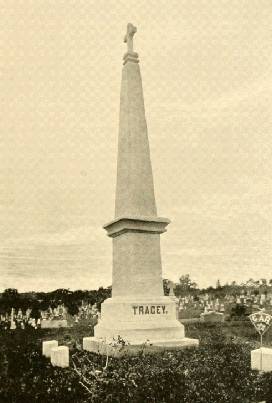
St. Anne's Church, of which Mr. Tracey was the founder. The Tracey Memorial - St.
Agnes Cemetery This beautiful memorial, erected to the memory of the late John Tracey,
is one of the most imposing in the Cemetery. In design it consists of a white
marble shaft, on which rests a graceful cross, the whole towering above the
surrounding foliage. The plot is situated in one of the most picturesque
parts of the Cemetery, both by reason of the natural beauty as well as the
careful cultivation tendered by those who keep in loving memory those dear
ones who have gone "to that bourne from which no traveler returns."
From here one can obtain a view of the surrounding country, unsurpassed in
any other part of the grounds. |
|
3.1 John Tracey (Colonel), (1843-1897) son of John Tracey, was born
November 29, 1843. He was educated at George Wrightson's Academy and graduated
at Mount Saint Mary's College, Emmettsburg, Maryland, where he took his A.B. He
then travelled through Europe for a year. After a course at the Albany Law
School was admitted to the bar and began practice in the office of Peter
Cagger. After the breaking out of the civil war he entered the army as a
lieutenant, and served on the staff of Brigadier-General Michael Corcoran,
commander of the Irish brigade, seeing hard service in the Army of the Potomac
and being mentioned in dispatches for conspicuous gallantry. He was mustered in
as major of the Eighteenth Regiment, New York Light Cavalry, October 15, 1863;
was commissioned lieutenant-colonel, December 28, 1864, with rank from November
25, 1864. He was mustered out June 12, 1865, at New Orleans, Louisiana, with
the brevet rank of colonel, being then in command of his regiment. In 1867
Colonel Tracey married Katherine Clinton Vernam. About this time he became a
member of a firm of distiller in Albany, when he gave it up to assume an
editorial position on a New York Newspaper. They resided in the 1880 and 1892
Census at Long Island City Queens.
He was at
one time very prominent in the local politics of New York city, and was well known
as an advocate of the county Democracy as opposed to the old Tammany Society.
He had filled various offices in the municipality or New York, at one time
being a clerk of one of the courts, and was also a newspaper man or more than
ordinary ability, having served as editor or the now defunct New York Star and
other metropolitan newspapers. His experiences during political campaigns as
the principal official in charge of Democratic headquarters brought him a
widespread national acquaintanceship, and his genial manner and hearty
friendship for nearly everyone who met him were marked characteristics. He was
appointed superintendent of the Associated Charities in 1893, which was among
the best appointments made in Mr Cleveland's second Administration.He died of Bright's
disease at Providence Hospital Washington May 16, 1897. Their children were Minnie [Mary Spencer Tracey
born born 1868 Albany], Ernest Clinton [born Charles Wilson Tracey born 1 Jun
1869 Manhattan, New York married Elizabeth Jones died Baltimore Maryland] and
Katherine [Catherine Spencer Tracey born 25 Mar 1877 Manhattan, New York died
1943 buried Albany].
Ref:
17 May 1897 The Evening Times (NY)
18 May 1897 New York Times
|
1911
|
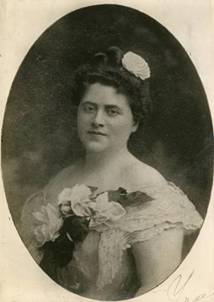
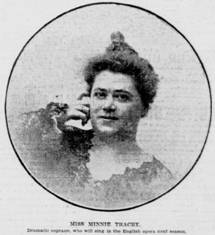
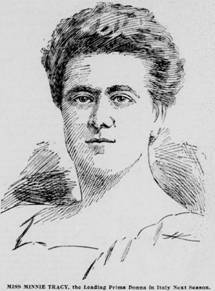
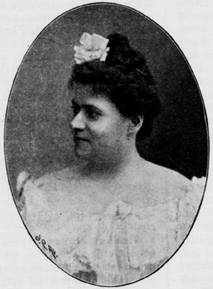
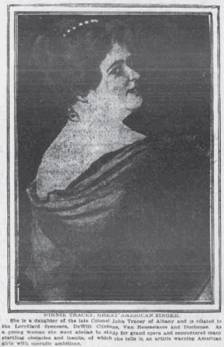
3.1.1 Minnie (Mary Spencer) Tracey (1868-1929) Minnie Tracey, the dramatic soprano who was heard with so much pleasure last night as Leonora In "Trovatore" and whose Santuzza In "Cavelleria" and Nedda in "Pagliacci" will be heard to-night, has received rare endorsement for one of her years. She was born In Albany, N. Y., and is a niece of General Tracey. Miss Tracey was seen at the Denison House yesterday and related the story of her career. "I always had the stage Idea." she said, "but my family opposed me. I was poohpoohed and silenced. My musical bent, however, they could not repress, and I was permitted to go to Paris to finish my vocal study. There, as an amateur, I studied with Marie Sass for two years and a half, a brilliant teacher, who had herself created the principal role in 'L'Africalne. By accident I was heard by Director Dauphin, of the Geneva Opera House, who offered me an engagement at once, but my teacher did not think at the first hearing that I was duly prepared. The director kept me in mind and the following spring asked me If I would sing before the abonnes of the Geneva opera, which I did. I made a success and was engaged at once. I made my debut in 'Faust.' my second appearance as Gllia in 'Rlgoletto’ and the third as Valentine In the 'Huguenots. I sang there for seven months and had the honor of singing Elsa for the first time in Franch in Geneva. I also sang there 'L’Africaine 'Alda Halevy's Mulve.' created 'Le Cid’, of Massenet: 'Iphlgenie. cf Gluck, and sang my French Elsa successfully about twenty-seven times. "Following I sang in special performances all through Belgium. I put in no idle time. I assure you. I created the role of Brunnhilda. in Nice, the following winter. "Dramatic, yes," said Miss Tracey, "that is my keynote in voice and action. In 1893 I sang at Covent Garden, London, my particular role being Donna Anna in 'Don Giovanni.' and then I had a host of social engagements which it grave me great enjoyment to fill. After London I went to Marseilles. I sang there twelve dramatic soprano roles and was unanimously received by the public and the extremely difficult, critical theatrical commission. Of course, you understand the very taxing mode there. You make three appearances. At the final one the director comes forward and demands In very plain terms from the public: 'Do you or do you not want her? There is no varnish on his question, any more than there is on the public reply, which, if they feel that way, will be a violent hissing for you just as soon as anything else. Well, they accepted me with cheers. Last winter I was leading prima donna in the opera house at Cairo, and much did I enjoy the Orient and Oriental appreciation and enthusiasm, which the Khedive heads so consistently. Incidentally I sang in Geneva, my pet corner of Europe by reason of my debut and the great success and encouragement obtained there. In Cairo I sang ia Cavalleria. 'PaJtllacci’ Bruneau's L'Attaque du Moulin.’ Delina’s great role and several others. "Since my debut on the stage I have studied with Tequi, a great Paris teacher famous for diction and better known to the artistic and, professional than the average music loving world. How much I think of him and of the good he has accomplished for me I can hardly express. He Is a very great teacher. The Magical Courier has the following complimentary words for Miss Tracey: "Miss Minnie Tracey has been rapidly winning in her own country, since her arrival, unstinted popularity and admiration. Small wonder is this to those who have followed the young singer's swift and sure artistic career in Europe. Three gifts belong to Miss Tracey Indisputably: A live, intelligent and extremely interesting personality; a full, rich, admirably trained voice and a dramatic power which distinguishes her on the operatic stage as an unusually capable and magnetic actress." In 1915, due to
the war in Europe, she planned an opening of an American Opera Comique on
Broadway NY. She set up a new organization known as the French Opera Comique
Company of America and was to leave for France to secure singers and rights
to several productions. In October 1915 she became a staff member of the
Cincinnati Conservatory of Music. In 1917 she was a vice-president of the
National Opera Club of America. She died 29 Jan 1929 in Cincinnati Ohio and
was buried in Albany. April 19, 1929
The Cincinnati Enquirer (Ohio) Minnie S.
Tracey's Will Filed. Under the will of Miss Minnie Spencer Tracey, widely
known singer and music teacher, who died a few weeks ago, all her cash Is to
be divided equally between her sister, Catherine S. Tracey, and her brother,
Ernest C. Tracey. Baltimore, Md. Her Jewelry she disposed of among her
relatives, and the residue of her estate, which consisted of her personal
effects, she gives, to her brother, who, she says, he knowing her desires,
will distribute them to friends and relatives as keepsakes. Ref: 29 February
1896 Indianapolis Journal (Indiana) 2 September
1897 The San Francisco call (California) 26 August 1900
New-York tribune (New York) 2 Sept 1900 The
St. Paul Globe (Minnesota) 15 Oktober 1901 Nordiskt Musikblad. Stockholm
(Sweden) April 01, 1913 Omaha daily bee (Nebraska) |
3.2 Louisa Tracey (Jan 1845 - 24 Aug 1845 New York)
3.3 Charles Tracey
(General) (1847-1905), son of John
Tracey, was born at No. 757
Broadway, Albany, New York, May 27, 1847, died in the same city, March 24, 1905. He
attended primary schools, and then entered the Boys' Academy, where he was
graduated in the class of 1866. He had a natural aptitude for military drill
and was major of the cadet battalion. In 1866 he went abroad, visited the Holy
Land, and remained in Europe some time, and during the period enlisted and
served two years in the Pontifical Zouaves, returning home in 1869. In 1870 he
went to Rome and took part in the siege of that city against the king's forces.
He was captured and held a prisoner for a time. He returned to New York City
and engaged in business. He there organized the Catholic Union, which in a short time had a membership of
over one hundred thousand, and became its first secretary. He then returned to
Albany, which was ever after his home. After returning from his military career
in Rome, Pope Pius IX, conferred upon him the order of St. Gregory the Great
with the rank and title of Chevalier.
18 October 1870 (FJ) Journal
of a Pontifical Zouave
Keyes O'Clery...I was accosted on the steps of the Orlando by my friend Mr.
Charles Tracey, of Albany, who served with me in the Zouaves in 1867, and had
just come all the way from New York to take his place again at the post of
danger...We left Rome...On the following day Colonel De Charette invited me in
company with Captain D'Arcy and Mr. Tracey to go on board the French frigate L'Orinoque,
which had arrived to take off the French Zouaves to Marseilles...
His life from this time was devoted to the public
service, being elected
Congressman four times. He was an unwavering Democrat, and first held several
entirely honorary offices. He was on the staff of Governor Tilden with the rank
of colonel, and under Governor Robinson was commissary-general. In 1887 he was
nominated and elected to congress to fill a vacancy. He was elected by the large majority of 1,659
over Hon. John M. Bailey, the popular republican candidate. He at once took
a leading position in the house, and the first fruit of his labor was the bill
for "the continuance of the manufacture of large cannon at
Watervliet." In September the appropriation for the Watervliet gun factory
was passed and signed by President Cleveland. In 1888 he was renominated and
elected for a second congressional term. On the occasion of his re-nomination the Albany Morning Express (rep.)
very generously remarked: "Gen. Tracey is young, energetic, intelligent,
with plenty of leisure for his public duties, and the tastes which lead him to
enjoy their punctilious discharge." Gen. Tracey was elected over his
political opponent, Moses V. Dodge of this city, by a majority of 2,306. He served that
term with especial credit and benefit to his district. He introduced and forced
to passage many important measures, one of which was "to enforce the
eight-hour law on government premises." So well was his work appreciated
that in 1890 he was again elected to congress. He was elected over Mr. A. McD. Shoemaker, the
republican nominee, by the magnificent majority of 5,078. He was especially
honored by President Cleveland, who
also tendered him a diplomatic position as minister abroad, which he declined.
He
was his spokesman on the floor of the house. During the presidential campaign of 1896 he was especially conspicuous,
serving as the New York member of the Democratic National Committee of the
sound money wing of his party. He rounded out his last congressional term full of
honors, leaving a record without a stain, and at the time of his death was the
national chairman of the Gold Democratic party. He took strong ground on sound
money, tariff and labor questions. He was quiet, unassuming in manner, sunny in
disposition, firm in his opinions, an ideal, true and courageous standard
bearer.
He held many positions of honor and trust outside
of his political ones. General
Tracey was actively identified with many business and other institutions of
Albany. He was elected a trustee of St.
Agnes Cemetery Association in 1875 to fill the vacancy caused by the death of
his father. Since its organization in 1886 he has been president of the
Columbia Distilling Company, which he had managed for ten years previously, and
which was founded by his father in 1838. For nineteen years he was a trustee of the Albany
Savings Bank, as was his father; was a director for fifteen years of the
National Commercial bank; He was
also vice-president of the Consolidated Car Heating Company of Albany, a life
member of the Burgesses Corps, and a member of the Catholic Union, the Fort
Orange and Albany Clubs, the Albany Press Club, the Dongan Club, and the
Manhattan and Reform Clubs of New York city. He was trustee of the
Boys' Academy; St. Agnes cemetery; manager of St. Peter's hospital, trustee of
the House of Refuge, at Hudson, appointed by Governor Cleveland and reappointed
by Governor Hill. He was a Catholic in religion, and when he was on his
deathbed, Pope Pius X cabled the papal benediction, an honour conferred on
prelates of the church. The beauty and purity of his life is thus expressed by a
friend:
|
"He kept the faith, he chose the purer thought, |
|
|
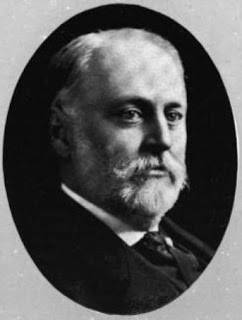
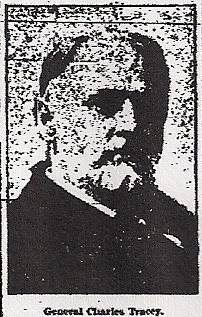
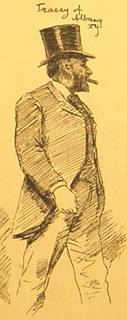
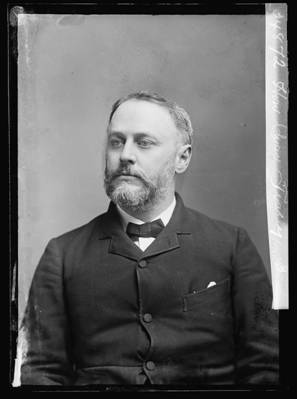
Hon. Chas. Tracey (circa 1880s) https://www.loc.gov/item/2016689319/ |
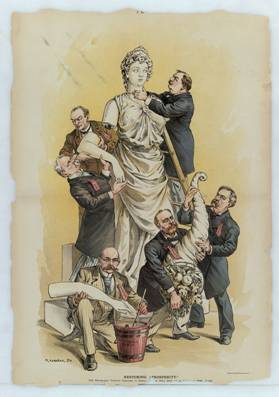
1893 Print shows President Cleveland and five
men using "Sound Policy Cement" to repair a statue labeled
"Nat. Prosperity". Shown with Cleveland are John G. Carlisle,
William L. Wilson, Daniel W. Voorhees, Charles Tracey, and Michael D. Harter. https://www.loc.gov/resource/ppmsca.29139/ |
In 1883 General Tracey married Hermine, daughter of Colonel Duchesnay, of
Montreal. They were the parents of five children, Marie T., Charles jr, Philip
D., John and James (deceased) (1897).
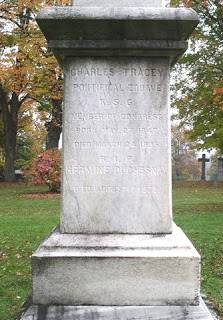
He was buried in St. Agnes Cemetery, Albany. His tombstone lists his
service in the Zouaves, his Knighthood of St. George and his Congressional
service.
http://pre-prowhiskeymen.blogspot.ie/2011/07/charles-tracey-mixing-politics-with.html
3.4 Eliza Tracey (Sister), daughter of John Tracey, was a member of
the Franciscan Order, in which she has taken the name of Sister Ambrosia and
was in 1911 Mother Superior in charge of St. James' Hospital, Newark, New
Jersey.
3.5 James Francis Tracey (Judge), (1854-1925) youngest son of John Tracey,
was born in Albany, New York, May 30, 1854. He was for four years a student at
the Boys' Academy, and toured Europe for two years as part of his preparatory
course. He entered on his return Georgetown University, where he was graduated
A. B., class of 1874. He was graduated LL.B. from the Albany Law School, and
was admitted to the New York bar in 1875. He studied in the office of M. T. and
L. G. Hun, and in 1882 formed a partnership with James Fenimore Cooper, and his
father, the late Paul Fenimore Cooper, who was senior counsel, under the firm
name of Tracey & Cooper, which continued until 1893. In that year Albert
Rathbone was admitted, and the firm became Tracey, Cooper & Rathbone,
continuing until Mr. Rathbone's removal to New York City, when he withdrew. His
place was taken by Frederick Townsend, the firm now being Tracey, Cooper &
Townsend, conducting a general legal business. Mr. Tracey served as state
examiner of corporations under John Bigelow when secretary of state, and was
lecturer on the law of corporations at Albany Law School for fifteen years.
From 1884 to 1886 he served as president of the Young Men's Democratic Club of
Albany, which did effective work towards securing for Grover Cleveland the
support of the party organization and in promoting his nomination. In 1905
President Roosevelt appointed him associate justice of the supreme court of the
Philippine Islands, and he took up his temporary residence in Manila. On
January 8, 1908, the president sent his name to the United States senate as
member of the Philippine commission with portfolio as minister of finance and
justice. This appointment he declined, and on February 1, 1909, resigned from
the insular service, and, returning to Albany, resumed practice of the law with
his old firm. He is connected with various Catholic charities, and belongs to
the Cathedral congregation. In politics he is a Democrat, and at times has
taken an active part in political movements, but has never been a candidate for
political office. He belongs to the Fort Orange, University and Country clubs
of Albany; the University and the Catholic of New York City, and the University
of Manila. In 1910 he received the degree LL. D. from his alma mater,
Georgetown University.
Judge Tracey married on May 10, 1893, Lucianne Bossé, of Quebec, Canada,
daughter of Joseph G. Bossé, judge of the Court of Queens Bench (Court of
Appeals), and his wife, Amelie de Salaberry, of an old French family which yet
retains its ancestral seats upon the Loire, and at St. Jean Pied du Port in the
Pyrenees. She is a great-granddaughter of Colonel de Salaberry, who commanded
the British and Canadians at the battle of Chateaugay in 1812, when the
Americans were defeated. Judge James F. and Lucianne (Bossé) Tracey have one
son, Walter aged sixteen years. (1891)
Pamphlet:
Catholic Union of the City of Albany, address of James F. Tracey (out-going
president), delivered Tuesday, July 7th, 1891
|
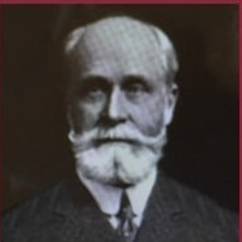
Judge James Francis Tracey |
1880 Census – 21 Clinton Street, Albany, Albany, New York
Charles Tracey Self Male 33 New York, United
States, parents born Ireland, distiller
Louise Tracey Sister Female 31 New York, United States, parents born
Ireland, lady of the house
James Tracey Brother Male 26 New York, United States, parents born
Ireland, lawyer
Kathie Kearney Other Female 22 Ireland, servant girl
Ref:
Noted living Albanians and state officials. A
series of biographical sketches. (1891).
Cooney, Myron A., (1899) St. Agnes' cemetery; its past and present
associations; Albany.
Parker, Amasa J. (1897). Landmarks of Albany County,
New York. D. Mason & Co., Syracuse NY.
Reynolds, Cuyler ed. (1911) Hudson-Mohaw Genealogical
and Family Memoirs. Lewis Historical Publishing Company, Vol. I pp.255-7
|
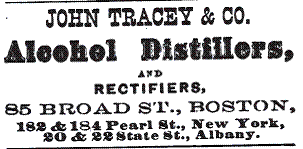
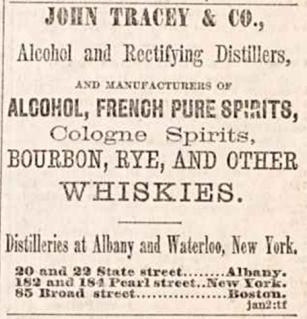
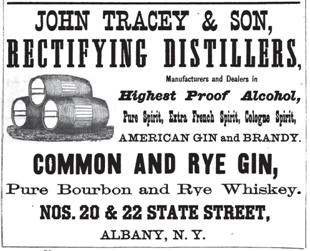
1869 Boston commercial directory
5 April 1873 Pilot (Boston)
1877
Albany Directory Sampson Davenport |
1853-54
Munsell's Albany Directory Tracey
Hugh, laborer, 140 Canal Tracey
John, distiller and wholesale dealer in wines and liquors, 20 and 22 State,
res 757 Broadway Tracy
Andrew, shoemaker, 61 Canal Tracy
C. W. & Co., patent oil and camphene, 372 Broadway, h 15 Liberty Tracy
Dennis, 110 Arch Tracy
John, laborer, 114 Canal Tracy
William H., laborer, 114 Green 1870-71
Gazetteer and business directory of Albany & Schenectady Co., N.Y. by
Hamilton Child. City
of Albany Tracey,
Chas., (John Tracey A Co.) Tracey,
J. Jr (John Tracey A Co.) Tracey,
John & Co. (J. Tracey Jr and Chas. Tracey) distillers and rectifiers, 20
and 22 State, 182 and 184 Pearl, and 85 Broadway. Tracy,
Eliza, ladies' nurse, 87 Fayette. Tracy,
Maurice, meat market, 192 Orange. Gazetteer
of Towns "Section
1. The territory within the following limits shall constitute the City of
Cohoes : Commencing at a point in the center of the south branch of the
Mohawk River, in the town of Watervliet and county of Albany, immediately
east of the south line of the farm owned by Cornelius L. Tracy and Sarah M.
Gould;... 1877
Albany Directory Sampson Davenport Tracey
Ann, widow, h. 114 Canal Tracey
Arthur, fireman, steamer 2, h. 109 Third Tracey
Charles, distiller and dealer in wines and liquors, 20 State, h. Schuyler
mansion Tracey
James F. attorney, 25 N. Pearl, house chuyler mansion Tracey
John, laborer, bds. 22 Orange Tracey
John Mrs. h. Schuyler mansion Tracey
J. B. clerk, 530 Broadway, h. 75 Second Tracey
Michael, laborer, h. 60 Lawrence Tracey
Michael, bds. 9 Lancaster Tracey
Michael, mason, bds. 114 Canal Tracey
Patrick, switchman, h. 36 Van Woert Tracey
Patrick, laborer, h. 66 N. Lansing Tracey
Sarah Miss, dressmaker, b. 66 N. Lansing Tracey
Thomas, mason, bds. 114 Canal Tracey
Thomas, waiter, rooms 314 State Tracey
William, waiter, h. 39 Canal Tracy
Charles J. clerk, J. M. Bradstreet & Son Co. bols. 63 Park ave. Tracy
Edwin, pianos and organs, with Cluett & Sons, 265 River, Troy, h. 664
B'way Tracy
Egbert W. (Monteath & Co.), 26 State, h. 281 Hudson ave. Tracy
Henry P. h. 281 Hudson ave. Tracy
John, clerk, h. 95 Myrtle ave. Tracy
John, carman, h. 270 Orange Tracy
Julia, widow, h. Warren n. Hawk Tracy
May H. Miss, h. 281 Hudson ave. Tracy
(Michael) & Ryan (Dennis), auctioneers, 56 North Swan, boards 136 Third Tracy
Myron E. h. Broadway n. James, Bath (Bath-on-the-Hudson Village Assessor) Tracy
M. G. bds. 9 Lancaster Tracy
Samuel, butler, 71 Hawk, bds. do. Tracy
Samuel R. h. 281 Hudson ave. |

FAMILY TREE
1. Dennis
Tracy (-1835) & Anna Manifold (-1835)
1.1 John Tracy (8 Dec 1809 Ireland -1875 12 July 1875 Albany New York)
married Mary McCarthy (1812 Isle of Wight England - 1880) 3 Sep 1835
Sainte-Famille-de-Boucherville
1.1.1 John Tracy (1843-)
1.1.2 Charles Tracey (27 May 1847 Albany New York - 24 March 1905 Watkins
Glen Dix Schuyler New York) married Anne-Marguerite Hermine Juchereau Duchesnay
(1853-1923) 14 June 1883 Notre-Dame Montreal Quebec Canada
1.1.2.1 John Tracey (1892-1960)
1.1.2.2 Marie Thérèse Tracey (2 May 1884 Albany Albany New York - 27
November 1954 Manhattan New York City New York) married Basil Haliburton Anglin
(1881 New Brunswick Canada) 6 Dec 1916 Albany Albany New York)
1.1.2.3 Charles Joseph Tracey (22 September 1885 Albany Albany New York
- 28 July 1956 Guilderland Albany New York)
1.1.2.4 Charlotte Tracey (1886 United States -)
1.1.2.5 Philip Duchesnay Tracey (6 April 1887 Albany Albany New York -
28 April 1945 Albany Albany New York)
1.1.2.6 James F. Tracey (16 January 1889 Washington District of Columbia
- 20 November 1889 Montreal Quebec Canada)
1.1.3 Edward Tracy (1850-)
1.1.4 Eliza Tracey (1850-)
1.1.5 James Francis Tracey (1843-)
https://www.familysearch.org/tree/pedigree/landscape/KZND-Z23
Various Tracey Records for Quebec
28 octobre
1823 The Quebec mercury
Receipts
and disbursements of Quebec Emigrant's Society 1822-1823
To paid
passage of Widow Tracey and two children to Ireland £9.0.0
20 janvier
1830
11 mars
1841
Jésuites, à
Joseph Tracey, manoeuvre, demeurant à Québec
1869-1870
Quebec Directory.
Tracey,
Miss Catherine, spinster, 9 St. Michael st. St. Lewis
Tracey,
Thomas, laborer, 11.5 St. Croix st. St. Lewis
24 Jan 1873
Morning chronicle and commercial and shipping gazette (Quebec)
Music Hall
...Tracey
Brothers, Flying Trapese Performers...
La Minerve,
11 décembre 1894, mardi 11 décembre 1894
Tuee Par Le
Chloroforme Enquete Du Curuner
le coroner a
tenn une enquête à l'Hôpital
Victoria, eur le corpé de madame Hugh Treacy, vée Elisa rke, demeu- rant 38 Aver.ue du
collège McGill. . Madame Treacy
ent lécédée à l'hôpital, des effeta «lu
chtoroforme qu'on lui avait
adminiatré, atin de faire l'ablation
d'une lumeur au cervenn. La malade était à l'hôpital Victoria depuis cing semaines,
Le jury u rendu un
verdict dans lequel les médecins ne sont nhlieruent blémés, vu qu'ils ne
pou- vaient faire mieux.
Le Prix
courant : journal du commerce, 18 décembre 1896, vendredi 18 décembre 1896
NOUVEAUX
establissements
Treacy D
& Co . épic.; Margaret Ryan épie de Denis Treacy
TRACY
MURPHY
1891 Census
- Sherbrooke, Quebec, Canada
James
Tracy, 45, married, b. Ireland, RC,
merchant tailor, 14 employees
Helen E
Tracy, 45, married, b. Ireland, RC
Patrick J
Tracy, 19, son, b. Quebec, RC
William C
Tract, 18, son, b. Quebec, RC
Mary A
Tracy, 15, daughter, b. Quebec, RC
James A
Tracy, 13, son, b. Quebec, RC
Catherine E
Tracy, 11, daughter, b. Quebec, RC
Anne Jane
Tracy, 10, daughter, b. Quebec, RC
Elizabeth E
Tracy, 6, daughter, b. Quebec, RC
Catherine
Murphy, 78, mother in law, b. Ireland, RC
Mary Jean
Wittaker, 35, servant, b. Quebec, RC
7 octobre
1897 Sherbrooke daily record
Deaths.
Tracy — At
Sherbrooke, Oct. 6, James Tracy. aged 50 years, Funeral Friday at 9 a.m.
1901 Census
- Sherbrooke, Quebec, Canada
Ellen E
Tracy, head, 52, b. 1849 Ireland, widowed, RC
William C
Tracy, Son, 28, b. Qc
Minnie
Tracy, Daughter, 25, b. Qc
James
Tracy, Son, 23, b. Qc
Kate Tracy,
Daughter, 21, b. Qc
Lulie
Tracy, Daughter, 16, b. Qc
1911 Census
- Sherbrooke Sub-Districts 9-14, Quebec, Canada
Ellen E
Tracy, head, 63, b. Mar 1868 Ireland, widowed, R Cath, emigrated 1857
William
Tracy, Son, 38, b. Mar 1873 Quebec
Mimie
Richardson, Daughter, 33, b. Apr 1878 Quebec
Loulou
Richardson, Daughter, 25, b. Jan 1886 Quebec
18 mars
1924 Le devoir
Feu T abbé
P.J. Tracy Sherbrooke, 18 (D.N.C.)
— M. l’abbé Patrick John Tracy, fils de feu
James Tracy et frère de M. W. C. Tracy, avocat, est décédé hier, après une
longue maladie. Il était né à Sherbrooke, le 11 juin 1871 et fut le premier
enfant irlandais de Sherbrooke à être élevé à la dignité de prêtre. Les
funérailles auront lieu demain matin à l’église St-Patric
22 novembre
1930 Sherbrooke daily record
MRS.
GUSTAVE RICHARD PASSED AWAY IN MONTREAL
The remains
of Mrs. Gustave Richard (Catherine Elizabeth Tracy) whose death occurred at her
home in Montreal on Thursday, arrived in this city last evening, and were taken
to the residence of her mother, Mrs. Ellen Tracy, 18 Ball street. Mrs. Richard
had until about four years ago resided in this city, where shi enjoyed a large
circle of friends. She was born in Sherbrooke the daughter of James Tracey and
Ellen Elizabeth Murphy Tracy, and after her marriage to Mr. Gustave Richard,
who predeceased her, resided here. About four years ago she went to Montreal to
live, where her daughter, Mrs. Paul H. Morin, resides, Mrs. Richard is survived
by her mother, Mrs. Ellen Tracy, one daughter, Mrs. Paul H. Morin (Hel en
Tracy), of Montreal; one grand daughter; two sisters, Mrs. M. Richardson and
Miss L. Tracy, both of this city, and other more distant relatives. The funeral
service is taking place tomorrow afternoon at St. Patrick ‘ s Church at
two-thirty o ‘ clock, followed by interment in St. Michael ‘ s Cemetery.
MAHY PAY
LAST RESPECTS TO THE LATE ®M. TRACY
Prominent
Professional and Busi ness Men Attended Funeral Held on Saturday Morning. The
funeral of the late William Cahill Tracy, K.C., whose death occurred on
Thursday last, was held on Saturday morning from his late residence, IS Bail
Street, to St. Patrick's Church, where the requiem mass was celebrated, and
thenc e to St. Michael ‘ s Cemetery, where the interment took place in the
family lot. The remains were received at the church door by Rev. Father H. A.
Simard, parish priest of St. Michael ‘ s Cathedral, while the requiem mass was
celebrated by Rev. Father Ray mond, of A'scot Corner, a former class mate and
lifelong friend of the deceased. Rev. Fathers Codere and Gosselin were deacon
and sub-deacon at the sendee. Rev. Father Fis- ette, pastor of St. Patrick ‘ s
Church; Rev. Father Simard, rector of the Cathedral; Rev. Father Letendre,
parish priest of Ste Jeanne d ‘ Arc; Rev. Father Huard, of the Sacred Heart
Hospital, and Rev. Father Parent, of the Bishopric, were pre sent in the
chancel. During the 'service the church choir, assisted by a large number of
the Cathedral choir, rendered very- appropriate music, the soloists being Mrs.
Shea, Mrs. G. Leclerc, Miss A. Codere, and Messrs. A. Genest and Bachand. Mrs.
Shea was th e organ- 1 st. The bearers, all former class mates of the deceased,
were Drs. J. A. Darche, J. A. McCabe, E. F. Gadbois, W. Lamy, J. C. St. Pierre
and W. Begin. Th e pall bearers, all members of the Sherbrooke Bar were Hon. J.
Xieol, John Leonard, K.C., F. Rugg, K.C., A. Gendron, L. Forest, K.C., and D.
Panneton. The late Mr. Tracy who was in the fifty-first year of his age, was
the son of the late James Tracy and Mrs. Ellen Elizabeth Murphy Tracy, Ball
Street. He was born in Sherbrooke, educated at St. Charles Seminary, and spent
all his life here, where he was a well known and highly respected member of the
Sherbrooke Bar, and his passing away will be keenly felt by his many friends,
who deeply sympathize with the family in their sorrow. The late Mr. Tracy
leaves to mourn his loss his mother and three sisters, Mrs. Richardson, Mrs.
Richard and Miss Tracy and one niece, Miss Helen Tracy. The beautiful and
numerous floral tributes, as well as the large number of spiritual offerings,
telegrams and expressions of sympathy which were received by the family, and
the large number of business and profes sional men, including the members of
the Sherbrooke Bar. who attended thg funeral, testified to the high esteem in
which the late Mr. Tracy was held by his many friends and former leg al
confreres.
18 décembre
1933 Sherbrooke daily record
MRS. E. E.
TRACY, OLDEST IRISH CITIZEN, DEAD
Member of
Old Sherbrooke Family Passed Away Yesterday in Ninetieth Year — Resident of
This City for Nearly Seventy Years. Sherbrooke ’s small Irish colony in
particular and citizens of other nationalities in general today mourn the death
of one of this city’s venerable old ladies, Mrs. Ellen Elizabeth Tracy, who
passed away at. her home on Ball street yesterday in her ninetieth year. A
member of one of Sherbrooke's oldest and best known families, Mrs. Tracy died
peacefully yester day morning, her death, hastened by a fall she suffered
some weeks ago. Of rare intelligence for a lady of her advanced years and one
who, by constant reading, was as well versed in present day affairs as she was
in events of importance of earlier history, Mrs. Tracy ’ s death removes one of
the few remaining links of Sherbrooke ’ s earlier days. A devoted mother and
kind friend, her demise creates a void in the family circle and deprives St.
Pat rick ’ s parish of one of its oldest members. Born in County Wexford,
Ireland, on March 6, 1853, the oldest of three children born to Patrick Muff
phy and his wife, Catherine E. Murphy, Mrs. Tracy came to this country and
settled in Quebec and Lennoxville before coming to Sher brooke nearly seventy
years ago. Sixty-three years ago, she married James Tracy, the late Father Du
fresne performing the nuptial ceremony in the old Cathedral on All Saints Day.
This union was bles sed with seven children, only two of whom survive. Predeceasing
Mrs. Tracy, besides her husband who pa.sed away thirty-six years ago, were
three sons, Rev. Father Patrick Tracy, parish priest at Cheenboro, Que.,
William Cahill Tracy, K.C., former Crown Prosecutor for the District of St.
Francis, and James Tracy; two daughters, Ann Jane Tracy and Catherine E., widow
of Gustave Richard, of Sherbrooke and one brother, William Murphy, of
Vancouver. Surviving are one sister, Mrs. F. P,. Whittaker, of Bakers field,
Calif.; two daughters, Mrs. Mary E. Rkhardson and Miss Helen Louise Tracy, of
Sherbrooke; one grand daughter, Mrs. Paul Morin, nee Miss Helen Richard, of
Mont real, and one grea grand daugh ter, Adele Morin, of Montreal. The
funeral will be held tomor row' morning at St. Patrick ’ s Church, with interment
in the family lot in St. Michael’s Cemetery.
20 Dec 1933
Sherbrooke daily record (Sherbrooke, Quebec)
Funeral of
Mrs. E. E. Tracy.
Final
tribute of respect to the memory of Sherbrooke’s oldest Irish citizen was paid
yesterday when the funeral of Mrs. Ellen Elizabeth Tracy was held. Mrs. Tracy,
who was born in County Wexford, Ireland, was within three months of her
ninetieth birthday when she passed away on Sunday. The esteem in which she was
held by her many friends was i expressed in the floral tributes, Masses and
telegrams of sympathy, chief among which was a personal message of condolence
from His| Lordship, Bishop Osias Gagnon. Survivors present at the funeral were
Mrs. Tracy ’s two daughters, Mrs. Mary E. Richardson and Miss Helen Louise Tracy,
and her grand daughter, Mrs. Paul Morin, of Montreal. Left to mourn also is a
sister, Mrs. F. R. Whittaker, of Bakersfield, Calif., and a
great-grand-daughter, Adele Morin, of Montreal. Among those from out-of-town
attending the final obsequies were Paul Morin, of Montreal, and Fred Merry, of
Magog. The pall-bearers were Col. E. B. Worthington, J. H. Walsh, Dr. W. Begin,
Joseph Codere, Rosario Darche and Ernest Sylvestre, while the bearers were
Richard Millet, W. Murray, G. W. Murphy, W. MeManamy, Eugene Olivier and T. M.
Hawkins
Various Tracey Records for Albany
NY
http://www.connorsgenealogy.com/Albany/
Carlow
Margaret
Tracey (single)
Birth Date:
4 Dec 1884 [1885? State Reg]
Birth
Place: Co Carlow, Ireland
Age: 37
Residence:
Brooklyn, New York & Mass for 21 years
Passport
Issue Date: 1 Nov 1922
Father
Name: James Tracey
Father's
Birth Location: Ireland
Father's
Residence: Deceased
Emigrated
October 1st 1901
Neutralised
7th June 1921 Albany
1892-1924
Ellis Island Arrivals
Bessie
Tracey, Knocklmagad (Knocklonagad Carlow?) Ireland, 1913, 23 years, housemaid,
b. Knocklimagad, father ??? Traceey, Knockl?agad, [Knockclonagad] Co. Carlow,
to Albany
Cavan
December 4, 1843 (FJ) Repeal in America
Albany, NY...subscription announced...Keran
Tracey...Cavan...[or Tipperary]
Cork
Ellen Archdeacon
27 Apr 1892 Albany New York USA, died Fermoy Cork, to James F Tracey,
Councellor at Law, Albany, the surviving executor
MISSING
ADVERTISMENTS NORTH AMERICA
|
Name of Missing |
Home county |
Arrival |
AD Date |
SEEKER |
|
John
Tracey |
Youghal,
Cork |
New York
City, Roundout NY |
4/7/1846 |
Thomas Tracey
(brother) 485 Broadway, Albany NY |
1846 Boston Pilot
Of
John Tracey, a native of Youghal, co. Cork, who sailed from Liverpool in April,
1836, and landed in New York. When last heard from was in Roundout, N. Y. Any
information respecting him will be thankfully received by his brother, Thomas
Tracey, No. 485 Broadway, Albany, N. Y.
Dublin
1855 Naturalization
Declarations - Rensselaer Co
Justice Court, Troy NY
Christopher Tracy,
aged
40, of Dublin. Entered USA Jun 1854, Resides Albany Co, Applied Jan 241855
Galway
|
Name of Missing |
Home county |
Arrival |
AD Date |
SEEKER |
|
Thomas Tracy (capenter) |
Kiltullagh, Galway |
Albany, NY |
3/5/1851 |
Dennis Gurley (nephew) Media Co., Lodi, OH Contact: Mr. Wilson, Medina Co, Lodi, OH |
1851 Boston Pilot
Of Thomas Tracy, native of parish Kiltulla, county Galway, (by trade a carpenter). When last heard of was in Albany, N. Y. He, or any one acquainted with his whereabouts, would confer a favor by writing to his nephew, Dennis Gurley, care of Mr. Winson, Lodi, Medina County, Ohio.
1852 Albany
Co New York naturalization petitions for Irish born
Wm Tracy,
30, b. Galway, left from Dublin, Albany Co Oct 23
Kildare
1864 Albany
Co New York naturalization petitions for Irish born
John Tracy,
50, b. Kildare, left from Dublin, Albany Oct 24
Kilkenny
1836 Albany
Co New York naturalization petitions for Irish born
John Tracy,
34, b. Kilkenny, left from Waterford, Albany Nov 7
1838 Albany
Co New York naturalization petitions for Irish born
Dennis Tracy,
27, b. Kilkenny, left from Waterford, Albany Nov 6
1849 Albany NY Naturisations
John Treacy, 30, Co Kilkenny, Liverpool, Albany, Apr 3
1854 Naturalization Delarations Albany NY
Thomas Tracey, 36, Kilkenny, Waterford, Greenbush, Rens Co, Dec 11
1841- 1887 Interment Records
St. John’s Cemetery, Albany, NY
http://www.rootsweb.ancestry.com/~nytigs/StJohnsCemetery_Albany/StJohnsCemetery-Albany-Tom-Ty.htm
|
LAST NAME |
FIRST NAME |
NAMES OF PARENTS |
COUNTY / CITY |
NATION / STATE |
DIED AT |
DATE |
AGE |
LETTER |
NO. |
RANGE |
REMARKS |
PAGE |
|
Tracy |
Catherine |
|
Kilkenny |
Ireland |
|
April 8, 1855 |
26 Years |
|
|
Level |
Drowned |
107 |
Francis M. Tracy
One of the representative legists and jurists of
Kenton county is Judge Francis Michael Tracy, who is now judge of the criminal
and equity divisions of the circuit court of Kenton county, with residence and
official headquarters in Covington. Judge Tracy was born in West Covington,
this state, on the 5th of May, 1872, and is a son of Patrick and Julia
(Aylward) Tracy, both of whom were born in Ireland. The father was reared and
educated in the fair Emerald Isle, whence he came to America in 1840, at the
age of twenty years. He first located on Prince Edward Island, Canada, where he
remained two years, at the expiration of which he located in the city of Albany, New York, which continued to be
his home until 1850, when he took up his residence in Cincinnati, Ohio, where
he was successfully engaged in the grocery business for a number of years.
A History of Kentucky and
Kentuckians: The Leaders and Representative Men by E. Polk Johnson, Lewis
Publishing Company. 1912
Laois
1858 Albany
Co New York naturalization petitions for Irish born
Patrick
Tracy, 30, b. Laois, left from Liverpool, Albany Mar 20
Leitrim
1850 Albany
Co New York naturalization petitions for Irish born
Andrew
Tracey, 31, b. Co Leitrim Ireland, left from Liverpool, Albany Oct 26, 1850
1841- 1887 Interment Records St. John’s Cemetery, Albany, NY
http://www.rootsweb.ancestry.com/~nytigs/StJohnsCemetery_Albany/StJohnsCemetery-Albany-Tom-Ty.htm
|
LAST NAME |
FIRST NAME |
NAMES OF PARENTS |
COUNTY / CITY |
NATION / STATE |
DIED AT |
DATE |
AGE |
LETTER |
NO. |
RANGE |
REMARKS |
PAGE |
|
Tracy |
Catherine |
|
Leitrim |
Ireland |
Albany |
September 15, 1849 |
65 years |
|
|
E |
Dysentery Death |
46 |
Louth
13-10-1851 Western World, Liverpool to New York
Ellen
Tracer, 18, F, Servant, Drogheda [Louth], to Albany
Offaly
1841 Albany
Co New York naturalization petitions for Irish born
John Tracey,
31, b. Co Offaly, left from Dublin, Albany Aug 19 1841
1841- 1887 Interment Records St. John’s Cemetery, Albany, NY
http://www.rootsweb.ancestry.com/~nytigs/StJohnsCemetery_Albany/StJohnsCemetery-Albany-Tom-Ty.htm
|
LAST NAME |
FIRST NAME |
NAMES OF PARENTS |
COUNTY / CITY |
NATION / STATE |
DIED AT |
DATE |
AGE |
LETTER |
NO. |
RANGE |
REMARKS |
PAGE |
|
Tracy |
Catherine |
Andrew & Mary |
Kings |
Ireland |
Albany |
August 14, 1849 |
37 years |
|
|
F |
|
42 |
Tipperary
1841- 1887 Interment Records
St. John’s Cemetery, Albany, NY
http://www.rootsweb.ancestry.com/~nytigs/StJohnsCemetery_Albany/StJohnsCemetery-Albany-Tom-Ty.htm
|
LAST NAME |
FIRST NAME |
NAMES OF PARENTS |
COUNTY / CITY |
NATION / STATE |
DIED AT |
DATE |
AGE |
LETTER |
NO. |
RANGE |
REMARKS |
PAGE |
|
Triacy |
Edward |
|
Tipperary |
Ireland |
Albany |
October 26, 1847 |
30 years |
|
|
L |
|
17 |
1851
(January/February 1847) Enlistment for Mexican War
Andrew
Treacey, 27, grey eyes, auburn?hair, ruddy complexion. 5'7", b. Tipperary
Ireland, labourer, enlisted 1 Feb 1851 Albany, by Hayden, recruit, discharged 5
Mch 51 Regedect, discharged at Fort West? Ars? A recruit
1859 Albany Co New York naturalization
petitions for Irish born
Samuel Tracy, 24, b. Tipperary, left from
Liverpool, Albany Oct 14
1860 Naturalization Delarations Albany NY
Kearon Tracey, 33, Tipperary, Liverpool, Coxsackie, Oct 17 [or Cavan]
Tyrone
1841- 1887 Interment Records
St. John’s Cemetery, Albany, NY
http://www.rootsweb.ancestry.com/~nytigs/StJohnsCemetery_Albany/StJohnsCemetery-Albany-Tom-Ty.htm
|
LAST NAME |
FIRST NAME |
NAMES OF PARENTS |
COUNTY / CITY |
NATION / STATE |
DIED AT |
DATE |
AGE |
LETTER |
NO. |
RANGE |
REMARKS |
PAGE |
|
Tracey |
Thomas |
|
Tyrone |
Ireland |
Troy |
|
42 |
|
|
|
|
2 |
Waterford
MISSING
ADVERTISMENTS NORTH AMERICA
|
Name of Missing |
Home county |
Arrival |
AD Date |
SEEKER |
|
Honora
Treacy (Si Bridget) |
Leamy
Brien, Kilrossanty, Waterford |
Quebec 1843 Ottawa(Bytown), ONT Frankfort
Co., KY |
2/3/1850 |
Sylvester
Treacy (brother), 4 Bleeker St, Albany, NY |
1850 Boston
Pilot
Westmeath
1859 Albany
Co New York naturalization petitions for Irish born
Michael
Tracy, 21, b. Westmeath, left from Liverpool, Albany Oct 29
1860 Naturalization Delarations Albany NY
Hugh Tracy, 60, Westmeath, Liverpool, Albany, Mar 30
1841- 1887 Interment Records St. John’s Cemetery, Albany, NY
http://www.rootsweb.ancestry.com/~nytigs/StJohnsCemetery_Albany/StJohnsCemetery-Albany-Tom-Ty.htm
|
LAST NAME |
FIRST NAME |
NAMES OF PARENTS |
COUNTY / CITY |
NATION / STATE |
DIED AT |
DATE |
AGE |
LETTER |
NO. |
RANGE |
REMARKS |
PAGE |
|
Tracey |
Ann |
|
Westmeath |
Ireland |
Albany |
May 20, 1871 |
62 years |
XVI |
36 |
|
|
239 |
|
Tracey |
Etta |
Hugh & Hanora |
Westmeath |
Ireland |
Albany |
July 4, 1868 |
23 years |
36 |
XVI |
|
|
217 |
|
Tracy |
Hugh |
|
Westmeath |
Ireland |
Albany |
August 6, 1862 |
63 years |
XVI |
36 |
|
|
168 |
|
Tracy |
John |
|
Westmeath |
Ireland |
Albany |
October 22, 1859 |
54 years |
P |
34 |
|
|
145 |
|
Tracy |
William |
|
Westmeath |
Ireland |
|
June 4, 1852 |
46 years |
|
|
|
In Mr. Ledwick's Lot. |
74 |
Wexford
Col. Thomas
Henry Tracy, (1848-1925) M.C. Soc. C.E.,
D.L.S., P.L.S., O.L.S., M.B.C.A.M.E., M.E.I.C.
... Mr.
Tracy went to Albany and joined George Durand at the Albany State Capital under
Fuller & Laver, the architects. In 1871, after the great fire in Chicago,
he went to that city and remained a year, when he returned to London, but later
went to Albany, N. Y., and entered the office of the architect of the State
House at that place...
Aurora to New York 1856 [moved to Albany NY]
Susan Tracey, 44, b. 1812 Ireland, spinster [mother?]
Arthur Tracey, 18, b. 1838 Ireland labourer
John
Tracey, 11, b. 1845 Ireland
1860 Census - 7th Ward Albany City, Albany, New York
Susan Tracey Female 45 Ireland
Arthur Tracey Male 22 Ireland, boatman
John Tracey Male 20 Ireland, laborer
1870 Census - 162/304 Albany Albany New York
Susan Tracey Female 63 Ireland, keeps house
Arthur Tracey Male 28 Ireland, laborer
John Tracey Male 26 Ireland, laborer
1880 Census - 109/282/378 Albany Albany New York
Arthur Tracy Self Male 40 Ireland, Fire Engine Engineer
Anna Tracy Wife Female 33 New York, United States
Susan Tracy Mother Female 71 Ireland
Last
update: 22 June 2024